
A single holiday shift can trigger four pay rules at once. Here is how FLSA, wage determinations, state law, and the new overtime tax deduction stack up, and why the math is only half the problem.
Why Holiday Pay and Overtime Get So Complicated for Government Contractors
Ask ten payroll managers how holiday pay works and you will get ten confident answers. Several of them will be wrong in at least one place.
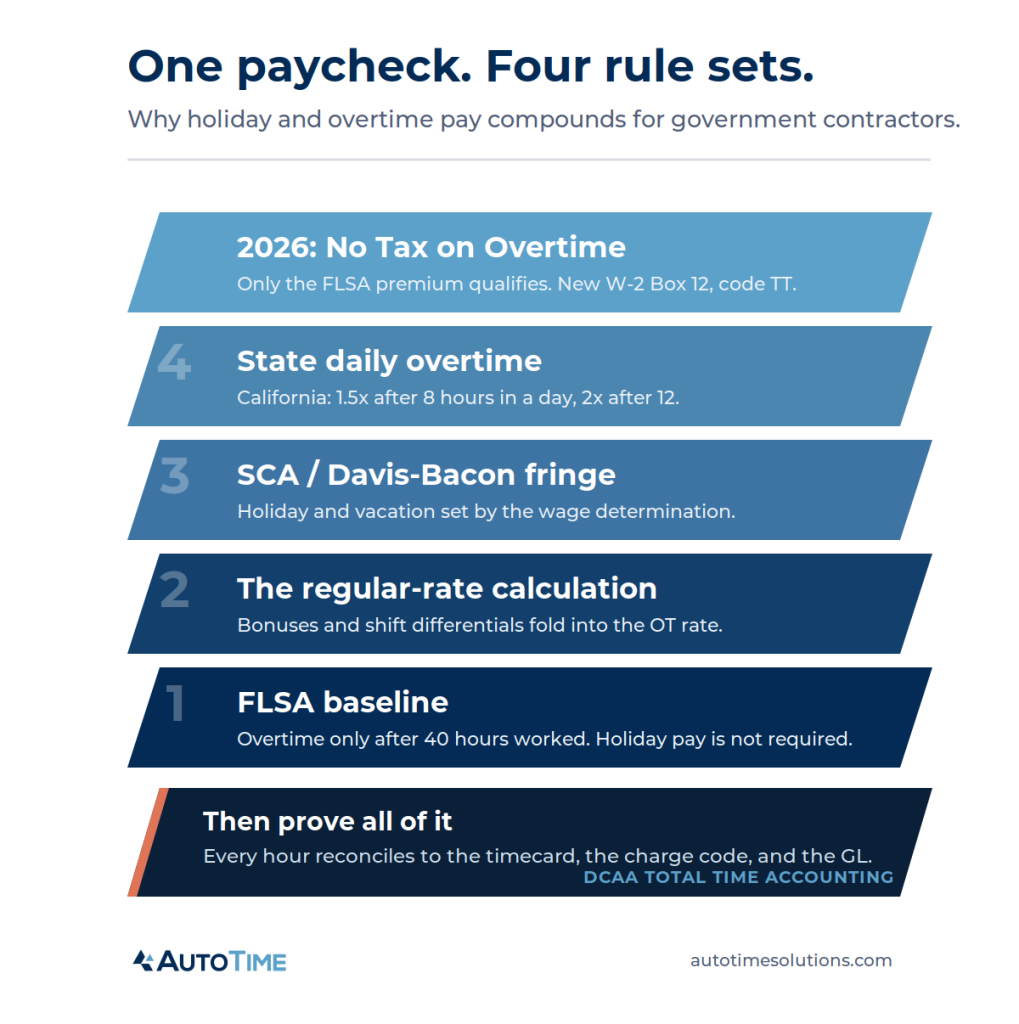
The everyday version goes like this. Holidays pay time and a half, overtime starts after 40 hours, and vacation is whatever the handbook says. Clean, easy to remember, and not how any of it actually works. Federal law is stricter and stranger than the folk version, and for aerospace and defense contractors, three more rule sets sit on top of it. A single shift worked on Friday, July 3, 2026 can touch the Fair Labor Standards Act, a Service Contract Act wage determination, a state daily-overtime statute, and a brand-new federal tax deduction, all at the same time.
Here is what actually governs holiday, overtime, and vacation pay in 2026, layer by layer, and why getting the calculation right is only half the job for a company that bills labor to the government.
Layer 1: What federal law requires, and what it does not
Start with the surprise. The FLSA does not require holiday pay at all. It does not require a premium for working a holiday, and it does not require the day off with pay. Working Thanksgiving earns the same rate as working a Tuesday, unless your own policy, a contract, or a collective bargaining agreement says otherwise.
Overtime works the same way. The Act triggers overtime on hours worked, not on the calendar. Time and a half is owed for hours worked beyond 40 in a workweek, and that is the only federal trigger. Saturdays, Sundays, holidays, and night shifts carry no premium under federal law on their own.
The part that catches payroll teams: paid time off does not count as hours worked. If an employee takes Independence Day as a paid holiday and logs 36 hours across the rest of the week, that is 44 paid hours but only 36 worked. No overtime is owed, because the 8 holiday hours were never worked. The word doing all the labor in the statute is worked.
Two footnotes matter more than they look. First, your own policy can change this. If your handbook says holiday hours count toward the 40-hour overtime threshold, then they do, and you are bound to it. Second, a few states write their own rules. Rhode Island requires time and a half for work on state holidays and Sundays for many private employers. Massachusetts restricts certain holiday work through its Blue Laws. Multi-state contractors carry those exceptions employee by employee.
One 2026 quirk is worth flagging to payroll now. Independence Day falls on a Saturday, so the observed federal holiday shifts to Friday, July 3.
Layer 2: The regular-rate trap
Here is where good-faith employers underpay without meaning to.
Overtime is one and a half times the regular rate. Almost everyone reads regular rate as the base hourly wage. It usually is not. Under the FLSA, the regular rate includes nearly all compensation an employee earns in a workweek: the base wage plus nondiscretionary bonuses, shift differentials, and similar promised pay. You divide total straight-time earnings by total hours worked to get the true regular rate, then pay the half-time premium on that number.
The Department of Labor reaffirmed this in January 2026 with Opinion Letter FLSA2026-2, which addressed an employer paying drivers $12.00 an hour plus a performance bonus of up to $9.50 an hour. The employer calculated overtime on the $12.00 base alone. DOL said no. The nondiscretionary bonus is part of the regular rate, and overtime has to be recomputed to include it.
Walk through the math, because the size of the gap surprises people. Say an employee earns $15.00 an hour, works 45 hours, picks up a $1.00 evening shift differential on 30 of those hours, and earns a promised $100 bonus that week.
- Straight-time wages: 45 hours x $15.00 = $675.00
- Shift differential: 30 hours x $1.00 = $30.00
- Promised bonus: $100.00
- Total straight-time compensation: $805.00
- Regular rate: $805.00 divided by 45 hours = $17.89
- Overtime premium: $17.89 x 0.5 = $8.95 per overtime hour
- Premium owed on 5 overtime hours: $44.75
Calculate overtime on the $15.00 base alone and you would pay $37.50 in premium. The correct figure is $44.75. The $7.25 gap looks trivial for one employee in one week. Multiply it across a 300-person shop floor with quarterly safety and attendance bonuses and it becomes a back-wages liability that plaintiff attorneys look for on purpose.
Aerospace and defense shops run exactly the pay structures that create this exposure: shift premiums, hazard differentials, skill-based bonuses, and multiple base rates for one person across different labor categories. Every one of those has to fold into the regular rate before the overtime multiplier is applied. It is the kind of logic that belongs in the system that sorts regular, overtime, and unpaid time at entry, not in a spreadsheet after the fact.
Layer 3: Service Contract Act and Davis-Bacon fringe benefits
Now add the layer that only federal contractors carry.
If your company performs service work on a federal contract over $2,500, the McNamara-O’Hara Service Contract Act likely applies. On construction contracts, it is Davis-Bacon. Under both, holiday and vacation pay stop being discretionary perks and become contractual fringe benefit obligations, spelled out in the wage determination attached to the contract.
This changes the game in three ways.
First, the fringe benefits are separate from and in addition to the monetary wage. The wage determination lists a minimum hourly wage and a separate health-and-welfare rate, set at $5.55 an hour as of July 2025, plus specified holiday and vacation entitlements. You cannot satisfy the fringe obligation by paying a higher wage, and you cannot satisfy the wage requirement by padding fringe. The two have to be tracked and paid separately, with records that show each amount on its own.
Second, the holidays and vacation you owe are the ones named in the wage determination, not the ones in your employee handbook. A contract might specify ten paid holidays and a vacation schedule tied to years of service. Apply your corporate policy instead of the contract terms and you have a compliance gap.
Third, a single company often runs several wage determinations at once, one per contract and locality, each with its own wage floors and fringe rules. The payroll team is reconciling different holiday and vacation entitlements for employees who might sit ten feet apart and charge different contracts.
Layer 4: State daily overtime and double-time
Federal overtime is a weekly test. Several states run a daily one on top of it, and California runs the strictest.
Under California Labor Code Section 510, a nonexempt employee earns time and a half after 8 hours in a single day, double time after 12 hours in a day, time and a half for the first 8 hours on a seventh consecutive workday, and double time beyond 8 hours on that seventh day. An employee can trigger daily overtime while working under 40 hours for the week. A 10-hour Tuesday earns 2 hours of overtime even if the rest of the week is light.
California also raised its exempt salary floor. As of January 1, 2026, an employee has to earn at least $70,304 a year, which is double the state minimum wage for full-time work, to qualify as exempt from overtime. Classify someone as exempt below that line and every daily and weekly overtime rule snaps back into force.
The governing principle for multi-state contractors is easy to state and hard to operate: when federal and state rules differ, you apply whichever one is more generous to the employee, per person and per location. A defense contractor with sites in California, Texas, and Virginia is running three different overtime regimes inside one payroll cycle.
The 2026 wrinkle: No Tax on Overtime
One more rule landed in 2025 that changes how overtime has to be reported, and it interacts with everything above. The One Big Beautiful Bill Act, signed July 4, 2025, created a temporary federal income tax deduction for qualified overtime, retroactive to January 1, 2025 and scheduled to expire December 31, 2028. Eligible employees can deduct up to $12,500 of qualifying overtime from federal taxable income, or $25,000 for joint filers, with the deduction phasing out above $150,000 of income, or $300,000 for joint filers.
The catch is in the word qualified. The deduction applies only to the premium portion of FLSA overtime, the half in time and a half. Not the base hourly portion. Not holiday premium. Not shift differentials. And this one matters for contractors in California and other daily-overtime states: overtime required by state law rather than the FLSA does not qualify, and neither does overtime required by a collective bargaining agreement. The federal weekly premium qualifies. The state daily premium does not, even though both land on the same paycheck.
That distinction has to live inside your payroll system, because starting with tax year 2026, employers are required to report qualified overtime separately on the W-2, in Box 12 under new code TT. For 2025 the IRS allowed a transition estimate. The 2026 requirement is firm. To report the number, you have to isolate the FLSA premium from every other kind of premium pay, hour by hour. A system that pours all overtime into one bucket cannot produce that figure.
Why this compounds for federal contractors
Step back and the pattern is clear. A commercial employer deals with maybe two of these layers. An aerospace and defense contractor deals with all five at once, for the same employee, in the same pay period. And for that contractor, calculating the pay correctly is only half the obligation. The other half is proving it.
That is the DCAA dimension. The Defense Contract Audit Agency expects Total Time Accounting, meaning every hour an employee works gets recorded and allocated, paid and unpaid, including the uncompensated overtime that exempt salaried staff often log without thinking about it. Holiday hours, vacation hours, and every flavor of overtime premium have to land on the correct charge code and the correct cost objective, because labor is usually the largest cost billed to a federal contract and the first thing an auditor tests.
Get a pay rule wrong and the consequences run past a payroll correction. Mischarged or unsupported labor becomes a disallowed cost. A pattern of it becomes a floor-check finding. And knowingly billing labor the records cannot support is the kind of thing the False Claims Act was written for. The regular-rate miscalculation that costs a commercial shop some back wages can cost a contractor a contract.
DCAA also expects segregation of duties. The people who keep time and the people who run payroll are not supposed to be the same hands. That control, sensible on its own, means the holiday and overtime rules have to be encoded into the system itself rather than patched by a payroll clerk after the fact.
The through-line
The more pay rules stack, the less the risk lives in the arithmetic and the more it lives in the evidence. Any competent payroll team can compute a regular rate. Far fewer can show an auditor, two years later, exactly which hours were FLSA overtime, which were California daily overtime, and which were SCA holiday fringe, all charged to the right contract and all reconciling to the timecard and the general ledger.
That is the real complexity behind holiday pay. It was never really about the multiplier.
AutoTime was built for this environment. Pay determination, premium splitouts, Service Contract and Davis-Bacon requirements, and overtime logic run in the background, so employees enter time and the system applies the right treatment automatically, hour by hour and code by code. Total Time Accounting is enforced at the source. Timesheets do not submit until 100% of hours are allocated, and the labor data lands clean in Deltek Costpoint, Oracle, or SAP before a pay run begins.
If your team is reconciling holiday, overtime, and vacation rules by hand across multiple contracts and states, that is worth a closer look. See how AutoTime handles complex pay rules for payroll teams and browse the resource library for A&D contractors.