
The federal market in 2026 is large, more concentrated, and less forgiving of sloppy operations than it has been in years. According to GAO’s “A Snapshot of Government-Wide Contracting for FY 2024” (June 24, 2025), the federal government committed about $755 billion on contracts in FY 2024 — a decrease of about $22.5 billion from FY 2023 after adjusting for inflation. FY 2025 tracked in a similar range despite a 43-day government shutdown to open FY 2026 and a continuing wave of DOGE-driven terminations. U.S. GAO + 2
The buying pattern is consolidating. The number of unique, standalone contracts is declining. The contractor pool is shrinking — especially among small businesses. And the vehicles are getting larger. For business development, capture, proposal, and contracts leaders, the old rhythm — find a procurement, write a proposal, hope to win — is no longer effective. Now, it’s critical to capture discipline, pricing realism, demonstrable accounting system adequacy, and present a clean past performance record.
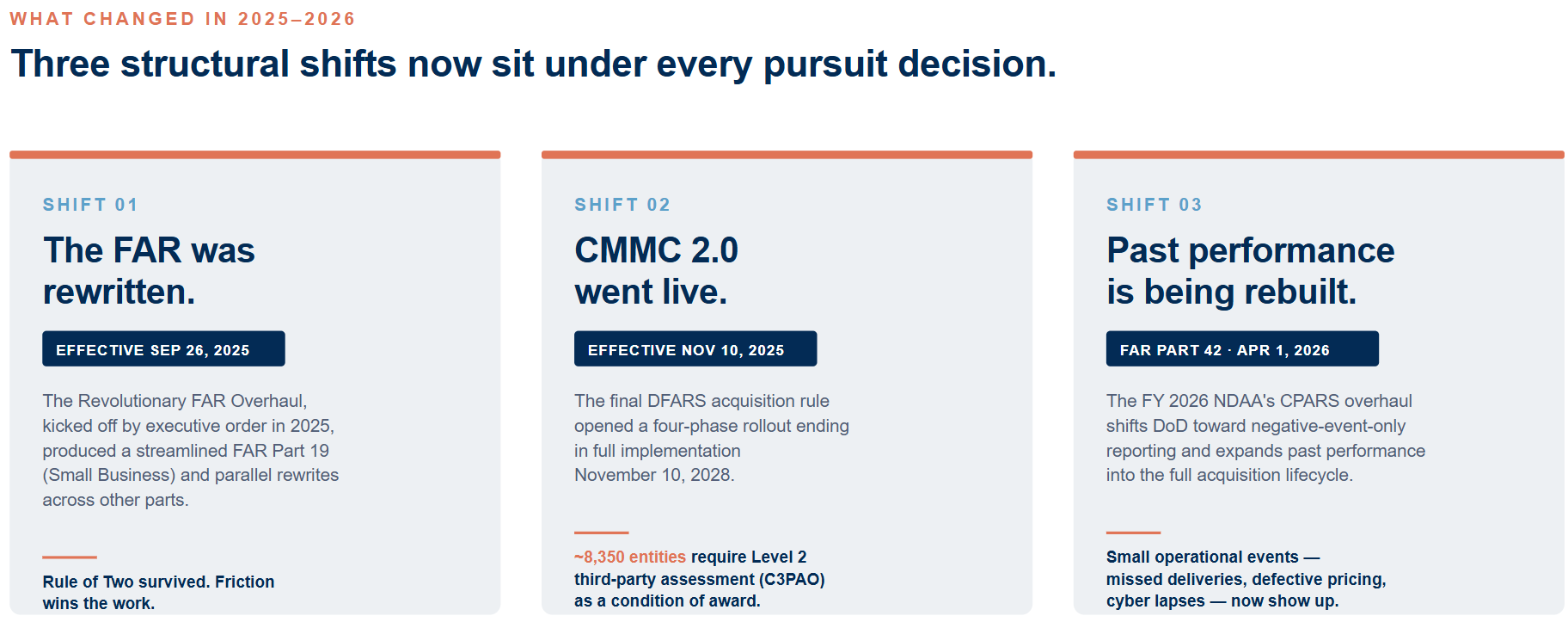
What changed in 2025–2026 that reshapes how you win
Three structural shifts now sit underneath every pursuit decision.
First, the FAR has been rewritten. The Revolutionary FAR Overhaul, kicked off by executive order in 2025, produced a streamlined FAR Part 19 (Small Business) published September 26, 2025, and parallel rewrites across other parts. The Rule of Two survived. Agencies are leaning harder on established vehicles, and contractors who reduce friction win the work. PilieroMazza PLLC
Second, CMMC 2.0 went live. The final DFARS acquisition rule took effect November 10, 2025, opening a four-phase rollout that ends in full implementation on November 10, 2028. According to DoD’s own analysis cited in the rulemaking, approximately 8,350 medium and large entities will be required to meet CMMC Level 2 third-party assessment (C3PAO) requirements as a condition of contract award. The Level 1/Level 2 self-assessment population is far larger. Elevate + 2
Third, past performance is being rebuilt. The FY 2026 NDAA’s CPARS overhaul (Senate Section 867 / House Section 836) shifts DoD toward negative-event-only reporting and directs DFARS implementation within 180 days of enactment. A parallel FAR Part 42 change, effective April 1, 2026, expands the use of past performance information beyond source selection into the entire acquisition lifecycle. The takeaway is sharp: small, well-documented operational events — a missed delivery, a defective pricing finding, a cybersecurity lapse, a flowed-down clause that wasn’t actually flowed down — will now show up in the data agencies use to award and to exercise options. Govwin + 3
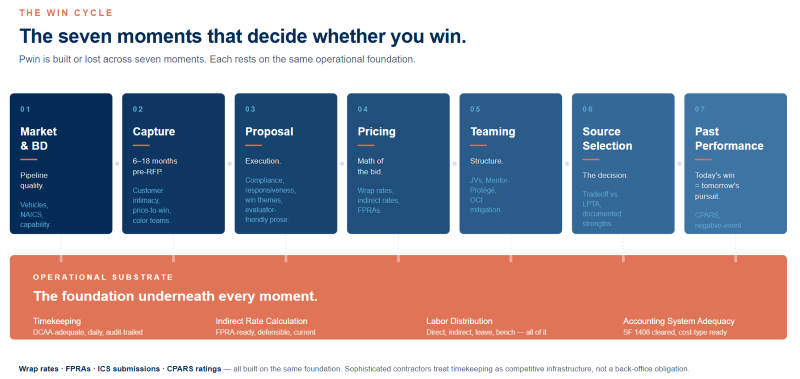
The seven moments that decide whether you win
Win probability is built or lost across seven moments.
The market and BD moment is about pipeline quality. With contract consolidation accelerating, if your capability statement and NAICS posture do not match where the agency actually buys — OASIS+, MAS, GWAC, OTA — your pipeline is theoretical.
The capture moment is the 6–18 months before RFP release, when win probability is shaped through customer intimacy, teammate selection, and price-to-win discipline. Shipley’s color-team framework still works; the discipline of running Pink, Red, and Gold reviews honestly is what separates contractors who win consistently from those who hope.
The proposal moment is execution. Compliance with the solicitation, responsiveness to evaluation criteria, win themes that ghost competitors without naming them, and tight, evaluator-friendly prose are the table stakes. The GAO Bid Protest Annual Report to Congress for Fiscal Year 2024 (GAO‑25‑900611, submitted November 14, 2024) puts it plainly: “Our review shows that the most prevalent reasons for sustaining protests during the 2024 fiscal year were: (1) unreasonable technical evaluation; (2) flawed selection decision; and (3) unreasonable cost or price evaluation.” That report also documents 1,803 cases filed, a 16% sustain rate, and a 52% effectiveness rate. gao + 5
The pricing moment is where wrap rates, indirect rate competitiveness, and Forward Pricing Rate Agreements (FPRAs) decide whether your number is in the zone. A wrap rate of 1.6 is competitive in many services markets; 2.2 puts you out of contention unless you bring a discriminator the customer will pay for. Govdash
The teaming moment is structural. SBA Mentor-Protégé joint ventures are a substantially bigger lever than a decade ago — and the rules around past performance crediting for protégés materially shift what’s biddable. OCI risk is rising; the FAR’s proposed OCI overhaul (moving from FAR Subpart 9.5 to a new Subpart 3.12) introduces firewall and mitigation requirements that will be priced into proposals. Wiley
The source-selection moment is where best value tradeoff versus LPTA gets decided. Congress restricted LPTA significantly through the FY 2017–FY 2019 NDAAs (DFARS 215.101-2-70 codifies the prohibitions) and DoD’s 2019 final rule. Tradeoff is the default for knowledge-based and services work. What evaluators look for is well-documented strengths, not adjective inflation.
The post-award/past performance moment is where today’s contract becomes tomorrow’s win. Under the new CPARS model, the absence of negative events is the asset.
Why timekeeping discipline keeps surfacing
You will see one thread running through every post in this series: timekeeping. Indirect rate calculation, labor distribution, and accounting system adequacy are the inputs that produce wrap rates, FPRAs, ICS submissions, and CPARS ratings. They are also the first thing a Contracting Officer examines when an SF 1408 pre-award accounting system survey hits — without that survey clearing, cost-reimbursable awards do not happen.
Most contractors treat timekeeping as a back-office obligation. Sophisticated contractors treat it as competitive infrastructure. The difference shows up in three ways: lower wrap rates because labor and indirect costs are clean and allocated correctly; clean floor checks that keep CPARS history negative-event-free; and faster pre-award surveys that let you bid cost-type work others can’t.
How to use this series
Each subsequent post stands alone as a reference for one stage of the win cycle. Keep an eye out for the next post in the series coming next week.
Take the 3-minute DCAA Timekeeping Compliance Assessment to compare your policies and procedures to the benchmark set by the DCAA. You’ll get a Strong / Moderate / At Risk score across six areas, with role-tailored views for HR, Finance, and Operations.