
Loose Timekeeping Is a False Claims Act Problem
The federal government recovered more money under the False Claims Act last year than in any year since the law was written. Most of the coverage went to healthcare, where the bulk of the dollars sit. For aerospace and defense contractors, the more useful signal is quieter and closer to the shop floor. It runs through the timecard.
Labor is the largest cost on most cost-reimbursable and time-and-materials contracts, and it is the line item auditors and prosecutors understand best. When billed hours do not match hours worked, the government does not treat it as a bookkeeping error. It treats it as a false claim. The uncomfortable part for most contractors is that the failures behind these cases are rarely the work of bad actors. They are process failures that a disciplined timekeeping system would have caught.
A record year, and where the risk actually sits
In the fiscal year that ended September 30, 2025, False Claims Act settlements and judgments passed $6.8 billion, the highest single-year total in the law’s history. That is more than double the $2.9 billion recovered the year before, and it clears the previous record of $6.2 billion set in 2014.
Be honest about the composition. More than $5.7 billion of that total came from healthcare matters. So why should a defense contractor pay attention? Two reasons. Whistleblowers filed 1,297 qui tam lawsuits, the highest number in a single year, and the government opened another 401 investigations of its own. And the Justice Department named procurement, alongside healthcare and customs, as a priority enforcement area for the year ahead. The mechanism that drives most GovCon exposure is not a headline settlement. It is one employee who decides the billing does not add up.
The case every program manager should read
On February 2, 2026, the Fourth Circuit affirmed the criminal conviction of the chief executive of a small IT firm that held a fixed-price level-of-effort contract with the National Security Agency. She had stepped into a senior program manager role that both the agency and her own company described as a quarter-time position, roughly ten hours a week. Over nineteen months she billed an average of more than thirty hours a week to the contract, almost always exactly eight hours a day, and charged the government close to $400,000.
Investigators found she was physically present at the secure facility for 259 hours, under ten percent of the time she billed, even though nearly all of the work had to be done on site. On one day she billed a full eight hours while driving out of state to drop her daughter at college. The appeals court needed one sentence to sum it up: a jury found she billed more time to the contract than she actually worked, and that is textbook fraud.
What makes the case instructive is not the conduct. It is the evidence gap. She did not enter her time daily, as company policy required. She reconstructed hours from memory, often days or weeks late, and threw away the notes she claimed backed them up. There was no contemporaneous, tamper-evident record to corroborate a single entry. When the billing was challenged, she had nothing to stand on.
Why the law treats a timecard as a claim
To win a civil False Claims Act case, the government has to show that a contractor submitted a false claim and knew it was false. On a cost-reimbursable or time-and-materials contract, every invoice built on labor hours is a claim. If the hours are wrong and the contractor should have known, the elements are met.
The penalties are what make it dangerous. The civil statute allows treble damages, three times the government’s loss, plus a separate civil penalty for every false claim. On a mid-size cost-plus contract, that math can exceed the value of the contract itself. The criminal exposure sits alongside it and, as the NSA case shows, it is real. Each monthly billing report there was charged as its own count, the executive was convicted on all of them, and she was sentenced to prison and ordered to repay the government.
The failures are procedural, not personal
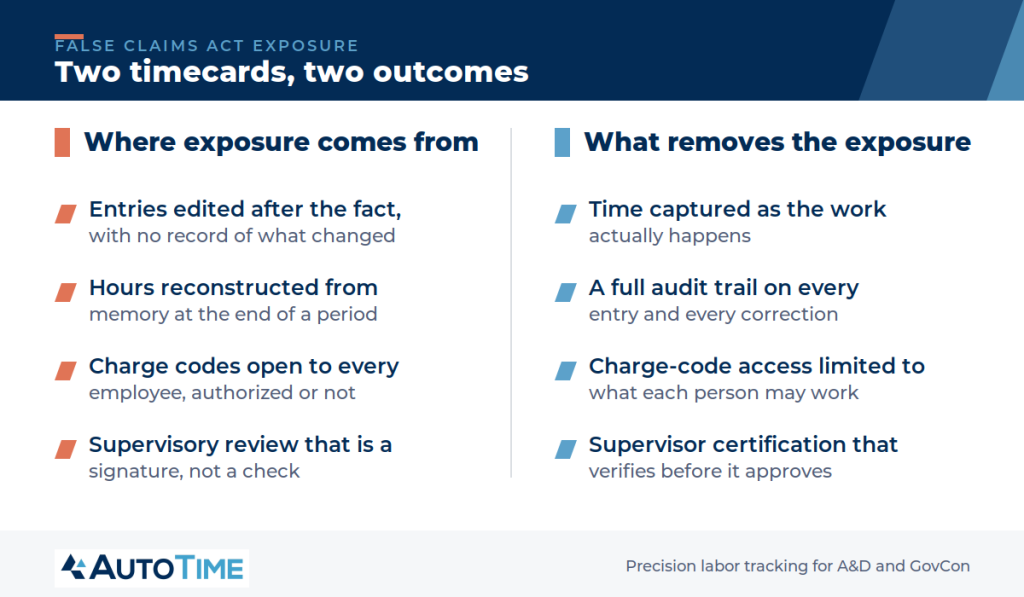
Most contractors are not hiding golf outings or concert tickets. The exposure comes from ordinary process gaps. A system that lets an entry be changed after the fact without recording what changed leaves nothing to prove the original was honest. Time entered from memory at the end of a pay period, rather than as the work happens, invites the same reconstruction problem that sank the executive in that NSA case. Charge codes visible to every employee, rather than limited to the contracts and tasks each person is authorized to work, turn mischarging into a matter of a wrong click. And supervisory review that amounts to a signature at the bottom of a sheet catches nothing.
None of that requires intent. It requires a system that cannot reconstruct who worked what, when, and against which charge code, on demand.
Your whistleblower probably sits in finance
The record 1,297 qui tam filings are a reminder that most of these cases start inside the company. In the NSA case, the person who first flagged the discrepancy was the executive who had just taken over approving timesheets. She compared billed hours against daily activity, saw the gap, and reported it. The people closest to your labor data are the people most likely to notice when it does not hold together, and the law gives them a financial reason to act. That is not a cause for suspicion. It is a reason to make sure the data holds together in the first place.
What audit-ready timekeeping looks like
Every one of these failures has the same fix, and it is not a bigger compliance team. It is a timekeeping record that stands on its own. Time captured as the work happens. A complete audit trail that shows every entry and every correction, with the person who made it and the moment they did. Charge-code access limited to what each employee is authorized to work. Supervisor certification that means something. Total time accounted for, including uncompensated overtime, so labor distribution stays honest across every contract.
Contractors that run their timekeeping this way do not scramble to prepare for a floor check or an incurred cost audit. They are already ready, because the evidence is built in.
AutoTime builds that discipline into daily timekeeping for aerospace and defense contractors, with a tamper-evident audit trail, charge-code controls, and supervisor certification designed for DCAA scrutiny. If you want a quick read on where your current process stands, the DCAA Timekeeping Compliance Assessment scores your readiness across six areas in about three minutes.